History
Introduction
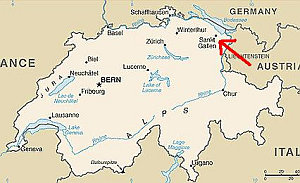 Sint Gallen is a fairly large city, situated in the north-east of the country Switserland.
This place got already in an early stadium a connection with a railway to the rest of the country.
Sint Gallen is a fairly large city, situated in the north-east of the country Switserland.
This place got already in an early stadium a connection with a railway to the rest of the country.
Trogen is a village in the canton Ausserrhoden, situated in the hills south east of Sint Gallen.
Speicher is a village, also situatied in the canton Ausserrhoden, about 3 km west of Trogen,
so between St.Gallen and Trogen.
In Trogen and Speichere there was in an early stage already some industrial places. When in 1886 the
railway from Herisau to Appenzell was created and in 1889 the railway from St.Gallen via Gais to
Appenzell, inhabitants of Trogen and Speicher would remark that they were in a backward position.
Already in 1856 there was a railway line in normal track to St.Gallen, and in 1872 there were
already talkings of a railway from St.Gallen to Trogen. Plans saw a line from St.Gallen to Teufen
(south of St.Gallen), where there would connect two lines. One to Gais and Appenzell, and another
to Speicher and Trogen. The first of these indeed was created, but an extension frmo Teufen to
Trogen did not see the light. For the inhabitants of Trogen it was the reason to make a commitee
to investigate a railway of its own.
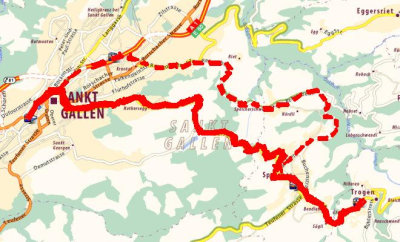 Several possibilities were studied. A line from St.Gallen over Speicherschwendi and Speicher to Trogen,
a line from Teufen over Speicher to Trogen, and a line from St.Gallen via St.Georgen to Trogen.
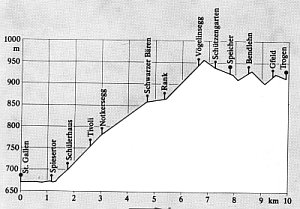
The shortest possibility over Vögelinsegg (as we know the line of today) was not investigated.
Grades of 75 promille were regarded as not possible for a steam railway (as was planned). In 1895 the
commitee advised to build a line from St.gallen over Speicherschwendi and Speicher to Trogen (see
the dotted line on the map).
Several possibilities were studied. A line from St.Gallen over Speicherschwendi and Speicher to Trogen,
a line from Teufen over Speicher to Trogen, and a line from St.Gallen via St.Georgen to Trogen.
The shortest possibility over Vögelinsegg (as we know the line of today) was not investigated.
Grades of 75 promille were regarded as not possible for a steam railway (as was planned). In 1895 the
commitee advised to build a line from St.gallen over Speicherschwendi and Speicher to Trogen (see
the dotted line on the map).
An unexpected change occured, when a plan was published by Du Riche-Preller for an electric railway
from St.Gallen over Vögelinsegg and Speicher to Trogen (the line as we know it today). He came from
Zürich, en was in connection with the well known firm of Brown-Boveri.
He thought that the steep slope of 75 promille was possible for an electric train. Many people
opposed the plan as not possible. His name was spoken over with some irony ('Preller' means in
German somebody with minor qualities). But because elsewhere in Switserland there were good
findings withs electric lines, also with steep gradients, and because the plan of Du Riche-Preller
was cheaper because of the shorter distance, it was decided to build the line as we know it today.
Opening
The line was opened on 10 july 1903 for passengers transport. Two days later in Speicher there were
large manifestations because of the celebration of the 500-year war in Vögelinsegg, a manifestation
to which many people came (3975 persons on one day). Goods transport was started only half a year
later. On 14 october 1903 the first goods transport took place.
De track width of the railway was, as in Switserland usually, 1000 mm. Voltage of the overhead was
1000 Volt. Electricity was made by a hydroelectric station which was situatied in Kubel at the
small river Sitter, just west of St.Gallen. The line had sharp curves; at several places there were
curves with a radius of only 25 meter.
On the opening day only 4 motor coaches, 2 coaches, 2 goods motor coaches, 2 closed goods vans and
3 open goods vans were present. Soon it appeared, that this was a too small amount. It even
occured that passengers had to be transported with the goods vans. Therefore in 1904 there came
2 more two-axle passenger cars, and 5 year later another 3 four-axle passenger cars.
For the stabling of the rolling stock and for maintenance in Speicher there was erected a shed and
repair shop. Since the opening is has two times been larged because of stabling the longer modern
rolling stock.
In St.Gallen in the main station there was rent a small room for administration and passenger service.
This was not a good choice. Therefore in 1912 negotionations witht the community of St.Gallen started
to build a station of its own. For the Trogener Bahn this was too much. It was not possible to pay
for such a large building. Because of this, negotioations with the SGA (St.Gallen-Gais-Appenzell railway)
started, of which came out that in 1914 a new station building was opened. The building was owned
by the community of St.Gallen, which gave it in rent to both railway companies. The rent was
split in 70% for SGA and 30% for TB.
Changes
 After the second world war there came more car trafic. Also in Switserland. The Trogener Bahn was
bilt as a railway laid in the street pavement. The many cars and the trains did not go together
very well. From about 1950 works were carried out to place the line as a line of its own. In the
city center of St.Gallen this is not possibly because of the small streets. But from Schülerhaus,
where the city ends, between 1950 and 1992 the line has been laid fully on a track of its own.
After the second world war there came more car trafic. Also in Switserland. The Trogener Bahn was
bilt as a railway laid in the street pavement. The many cars and the trains did not go together
very well. From about 1950 works were carried out to place the line as a line of its own. In the
city center of St.Gallen this is not possibly because of the small streets. But from Schülerhaus,
where the city ends, between 1950 and 1992 the line has been laid fully on a track of its own.
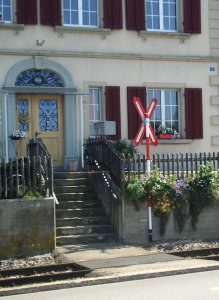
In the village of Speicher and Trogen the line is also laid on its own. Sometimes this looks some
strange. On the foto we see a railway crossing, inclusive the red Andreas cross. When we look good
we see, that after 2 meters the path only leads to the stairs of one house. But in general we can
say, that nowadays the line is free of the road as many as possible.
In the past years several improvements has been made. A simple but good light signal system,
automated selling points for tickets, improved electricity, in 1992 a large depot for the rolling
stock in Speicher, and many other modernisations will have as outcome that the line can be seen as
a modern railway.
Freight trafic, which was no more of modern times, has stopped at last in 1993. To the last time
there was only freight trafic for the Swiss mail, carried in a separate mail-coach.
With other companies
On 1 January 2006 several railway compainies in the canton of St.gallen have been taken into one
new railway company the AB (Appenzeller Bahnen). These companies are the AB (Appenzeller Bahn),
SGA (St.GAllen-Gais-Appenzell), TB (Trogener Bahn), RHB (Rorschach-Heiden-Bahn), RhW
(Rheineck-Walzenhausen bahn).
Date last changed : 1 august 2010